Create a new risk assessment or import an existing one.
📋 Which Risk Assessments Do I Need?
Start with the 5 standard assessments required for every service user, then complete a short screening checklist for any additional assessments.
Templates
Start a standard Margaret's Homecare template for a service user.
No risk assessments yet.
Original Risk Assessment File
Risks added
Add as many risks as needed. Each can be edited or deleted.
Import Existing Risk Assessment
Upload an existing PDF or Word (.docx) risk assessment. The portal will read the document and prepare editable details for you to check before saving.
The original file will be kept in private storage. PDF import now preserves table columns and page continuations. Please still review the imported details before saving because older documents can use different layouts.
Review Imported Risk Assessment
Check these details, then edit/add/delete risks normally after saving.
New PRN Protocol
Complete the protocol for the service user. Fields can be edited again after saving.
New Personal Emergency Evacuation Plan (PEEP)
Reason for PEEP
Procedure in the Event of an Emergency
Medication Support & Risk Assessment
Appendix 1 — to be completed by the Care Coordinator prior to service commencement. Use this assessment to determine whether the person self-administers or requires Level 1, 2 or 3 medication support.
1. Service User's Preferred Medication Arrangement
Record what the service user wants before completing the relevant part of this assessment.
Current Medications
Add each medication as a separate row. Use + Add Medication for additional medicines.
2. Medication Responsibility Arrangement
Record who is responsible for managing the service user's medication and exactly what they are responsible for.
A. Other Person / NOK / Healthcare Professional
B. Margaret's Homecare Services Ltd
Level 1 - Prompting / General Support The service user remains in control and takes their medication themselves. Staff can prompt/remind and provide general assistance such as opening packaging when requested. Staff do not select, prepare or administer the medicine.
Level 2 - Administration by Care Worker The care worker takes responsibility for preparing/giving the medication, including ensuring the correct medicine/dose/time. Administration is recorded on MAR/eMAR.
Level 3 - Specialised Administration Specialist route/technique such as PEG medication or insulin, requiring appropriate healthcare-professional delegation and staff training/competency.
The medication list above identifies who is responsible for each medicine. Use this section only to describe how the shared / partial arrangement works in practice. The Self-Administration Risk Assessment below must still be completed for the medicines the service user manages themselves.
Recording: Margaret's should record/sign MAR/eMAR only for medication support or administration actually provided by Margaret's. Medicines independently self-administered by the service user should be clearly identified in the care plan and medication records.
2. Self-Administration Risk Assessment
Complete this section when the service user wants to self-administer. It helps identify whether self-administration is safe and whether any risks, controls or further assessment are needed.
3. Self-Administration Outcome
Self-administration: For full self-administration, the care plan should state that the service user self-administers and care workers do not handle or sign MAR for those medicines. For shared / partial self-administration, clearly record which medicines or doses the service user manages and which Margaret's supports/administers; Margaret's records only the support or administration it actually provides.
4. Agreed Level of Medication Support
Complete this section when the service user wants Margaret's to provide medication support. Select the level that matches the support required.
Level 1 - Prompting / General Support The service user remains in control of their medication and takes it themselves. Care staff may prompt or remind the service user and may provide general assistance, such as opening medication packaging when requested. Staff do not take responsibility for selecting, preparing or administering the medication.
Level 2 - Administration by Care Worker The care worker takes responsibility for preparing and giving the medication, including ensuring the correct medication and correct dose are given at the correct time. Administration must be recorded on the MAR.
Level 3 - Specialised Administration The service user requires medication through a specialised route or technique, such as PEG medication or insulin, requiring appropriate delegation from a healthcare professional and specific training and competency before staff undertake the task.
5. Additional Medication Requirements
Identify any additional medication documents, controls or specialist arrangements required for this service user.
Create New Risk Assessment
Enter the assessment details first. You can then add risks one at a time.
Edit Risk Assessment Details
Update the assessment details. Existing risks will not be changed.
Moving and Handling Checklist and Risk Assessment
Appendix 2: Environmental Hazard Checklist
Check Yes, No, or N/A. Any No requires an immediate action plan.
Overall Environment Safe for Care Delivery?
Lone Working / Missed Visit Risk Assessment
Service-user-specific assessment of risks to staff working alone and the individual consequences of a missed visit.
Missed Visit / No Reply Risk
No Reply Information
Agreed Lone Working Control Measures
Access / Missed Visit Procedure If key-safe access is available and staff are authorised to enter, follow the agreed access arrangements documented in the care plan. If the service user cannot be located, there are unexpected circumstances, or there are concerns for their welfare, contact the On-Call Manager and follow the appropriate escalation procedure.
No Reply Procedure 1. Knock/ring and call out. Check accessible windows only if safe. 2. Wait approximately 2 minutes, try again and telephone the service user's home/mobile. 3. If there is still no reply and staff cannot gain authorised access, do not simply leave. Contact the On-Call Manager. 4. On-Call checks for known hospital admission/planned absence and attempts to contact Next of Kin. 5. If the person's whereabouts are confirmed, follow On-Call instructions. 6. If no contact can be made and the person is considered at significant risk, On-Call may instruct the worker to request a Police Welfare Check via 999 and remain safely outside/in their vehicle as instructed.
Overall Lone Working Decision
Service User Risk Assessment Checklist
The five standard assessments below are always required. Answer the additional screening questions to identify other assessments that should be considered.
Standard Assessments — Always Required
These are required for every new service user.
Additional Risk Assessment Screening
Answer Yes, No or N/A. A Yes will add the relevant assessment to the recommended list.
Assessment Checklist Result
Bed Rail Risk Assessment
Complete the checklist for the service user and record the final decision and any required mitigation.
1. Service User Factors
2. Equipment Factors
3. Decision & Mitigation
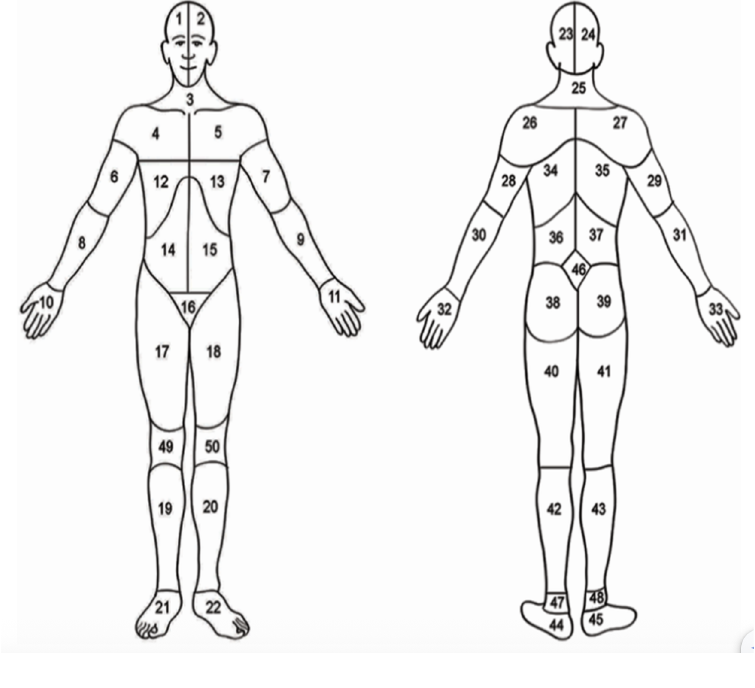
Barrier Cream Application Body Map Guide
Record exactly where barrier cream should be applied using the numbered front/back body map.
Use the numbers on the body map to identify the application areas.
Application Areas
Add Risk
Initial Risk Rating: -
Add each control measure separately and choose who is responsible for that particular control.
Residual Risk Rating: -
The system calculates L × S automatically. The assessor remains responsible for deciding the appropriate likelihood, severity and control measures.